7 Common Laundry Routine Mistakes That Cause Clutter
Laundry rarely becomes clutter because there's too much of it. It becomes clutter because the routine has gaps: a basket that never quite gets emptied, a chair that has quietly become a second wardrobe, a pile of socks waiting for their partners.
None of that needs a new appliance or a bigger utility room. It needs a few decisions made in advance, then repeated often enough that they stop feeling like decisions at all.
Here are seven common mistakes, and the fixes that make the weekly wash calmer.
1. Letting the basket overflow before you deal with it
A basket that's two-thirds full is easy to deal with. One that's heaped above the rim, with a towel wedged down the side, is the job you'll find reasons to avoid. That's when laundry starts travelling — a jumper on the landing, a pile on the bathroom floor, a stray sock on the stairs.
Fix: treat full as the trigger, not desperate. When the basket reaches the top, that's the cue to run a load — not when the last clean T-shirt has gone. If your basket lives in a cupboard, this is the one change worth making: put it somewhere you walk past every day, so you notice it filling instead of discovering it.
2. Sorting everything on wash day instead of as you go
The classic version of this is a Sunday evening spent on the bedroom floor with three piles and a growing sense of resentment. Sorting a mountain takes twenty minutes. Sorting as you go takes two seconds per item, and it happens while you're already holding the thing.
You don't need seven categories. For most households, three is plenty:
- Hot wash — towels, bedding, tea towels, anything that needs a proper clean.
- Everyday wash — most clothes, at a cooler temperature.
- Delicates or hand-wash — wool, silk, anything you'd rather not risk.
Fix: put three baskets — or two baskets and a mesh bag hanging on the door — wherever the clothes come off. If that's the bathroom, so be it. The bathroom is allowed to hold laundry. The goal is that by the time you carry the basket downstairs, the sorting is already done.
3. The chair in the corner that has become a wardrobe
Nobody decides to build a pile of half-worn clothes on a chair. It happens because there's no answer to a very specific question: where does a jumper go when it's been worn once and isn't dirty yet? Faced with that gap, most of us drop it on the nearest surface, and the surface fills up.
Fix: give "worn once" its own home. A hook on the back of the bedroom door, a single designated basket, or a short row of hooks on the wall. The important thing is that it holds a small, finite number of items — three or four, not thirty. Once the hooks are full, something has to be worn again or washed.
Clutter is usually a decision you haven't made yet, wearing a pile of clothes as a disguise.
4. Saving it all up for one marathon session
The all-day laundry marathon feels efficient and almost never is. Five loads in one day means five rounds of washing, drying and folding competing for the same machine, the same airing rack and the same tired evening. It also means long stretches where nothing is clean, followed by the sudden arrival of more clothes than you can comfortably put away.
Fix: run one load a day, or two fixed days a week, rather than waiting for a crisis. A single load takes only a few minutes of actual attention: start it, hang it, fold it, put it away. Spread across a week, laundry becomes background noise instead of an event.
5. Leaving the clean pile on a flat surface
This is the most common laundry mistake of all, and it doesn't look like one. The washing is done. The drying is done. The clothes are folded, neatly, on the spare bed or the end of the sofa. And there they stay, because the last step — putting them away — is the one with no deadline.
A folded pile in a shared room is also the first thing to get knocked onto the floor, sat on or borrowed from, which undoes the work in seconds.
Fix: fold where the clothes live. Carrying folded laundry upstairs is the step that gets skipped, so skip the carrying instead. If that isn't possible, set a rule: nothing folded sits out for longer than one evening.
6. Letting odd socks accumulate in limbo
Every household has one: the bag, the drawer, the shelf where single socks go to wait. The wait is almost always permanent. Meanwhile the pile grows, takes up space, and makes you feel vaguely guilty every time you open the drawer.
Fix: give the odd sock pile a deadline. Keep a small bag or a clipped-together bundle for a fortnight. When the fortnight is up, anything still alone gets repurposed or recycled — cleaning rags, the dog's toy, the textile bank. Socks are cheap and replaceable; the drawer space and the low-grade irritation are not.
7. Keeping more laundry than you can process
Clutter in the laundry routine often comes down to volume. Six sets of bedding, twenty towels, forty T-shirts, three baskets stacked in the hall — every extra item is another thing that has to be washed, dried, folded and stored. When the volume exceeds what your routine can handle, the routine loses every time.
Fix: run a rough count. Two sets of bedding per bed is usually plenty: one on, one in the wash. Towels can be pared back to two per person plus a couple of spares. Clothes that haven't been worn in a year are not "waiting for the right occasion" — they're clutter in a wardrobe, and they'll end up in the wash basket eventually just because they were moved.
A simple routine that holds up
None of the fixes above are complicated on their own. What makes them work is stringing them together into a rhythm you follow without thinking. Something like this:
- Every evening: clothes go into the sorted basket in the bathroom, not onto the chair.
- Three or four mornings a week: start one load before you do anything else, and hang it out or rack it as soon as it finishes.
- Same evening: fold that one load and put it away before bed. Ten minutes, maximum.
- Weekly: one hot load for towels and bedding, and a quick sweep of the "worn once" hooks.
- Monthly: empty the odd sock bag and take a look at anything the routine keeps struggling with.
The point isn't perfection. It's that the laundry never gets far enough behind to become a project.
What to do when you've fallen behind
You will fall behind. Illness, holidays, a busy fortnight — the pile grows, and the temptation is to attack it all at once, which is exactly how you got here in the first place.
Instead, work in one direction only:
- Start with the most used items. Underwear, socks, school or work clothes, gym kit. Nobody's mood improves because the decorative cushions got washed first.
- Do one load at a time, start to finish. Wash, dry, fold, put away. Resist starting a second load until the first is genuinely finished.
- Leave the odd socks until last. They're the least urgent item in the house and the most likely to derail you.
- Give yourself a cut-off. Once you're back to a manageable basket, stop. The last two loads can wait for the normal rhythm to pick them up.
The bigger picture
Laundry clutter is rarely about discipline. It's about missing defaults — no defined place for a worn jumper, no trigger for running a load, no deadline for the odd sock bag. Once those defaults exist, the work doesn't disappear, but the decisions do. And a routine that makes its own decisions is one you can keep running on a tired Tuesday.
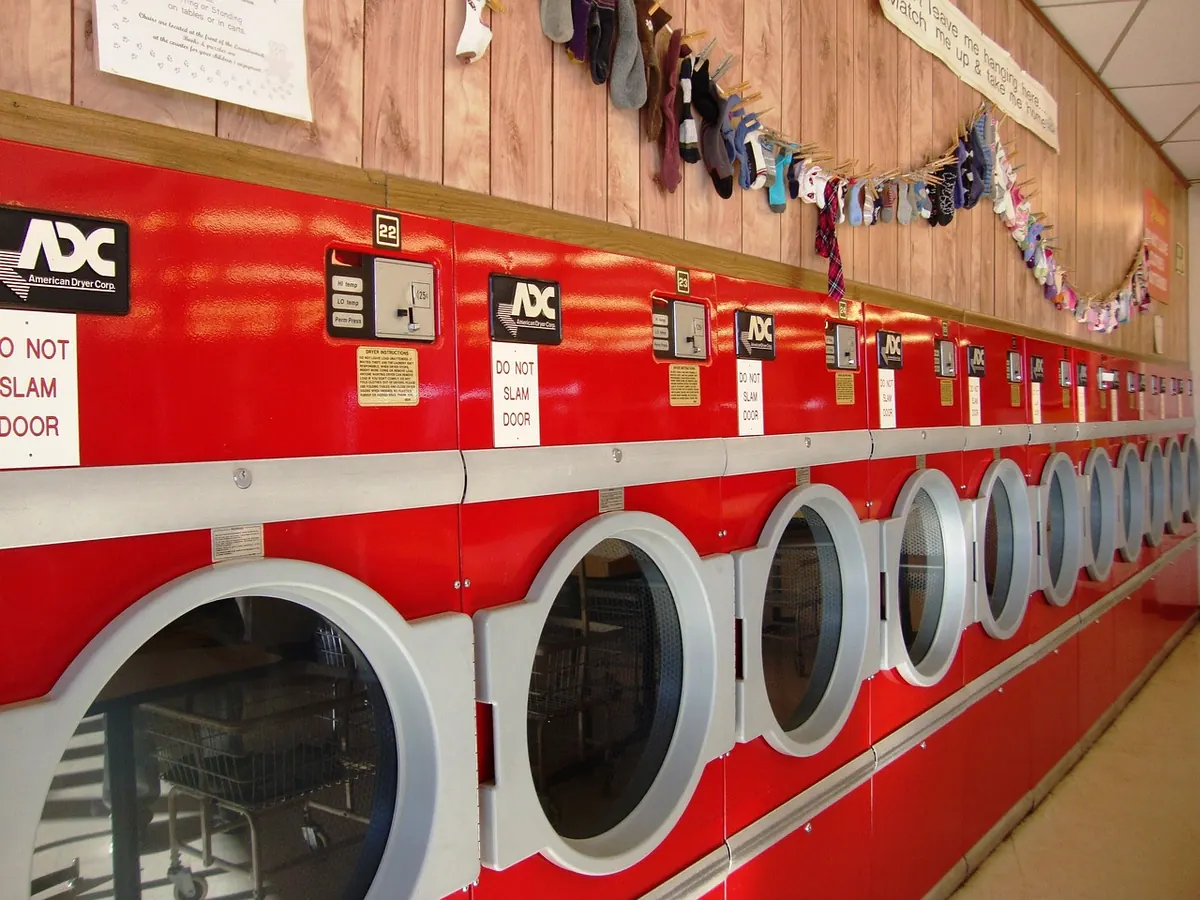
Photo: lacarabeis / Pixabay